

AI video products rarely fail only because of model quality. In practice, they fail because the surrounding system is not designed to handle the operational realities of video: large-file ingestion, long-running asynchronous workloads, partial failures, pricing enforcement, state visibility, and user interfaces that must communicate progress clearly without exposing unnecessary complexity.
LuminaCore AI was designed with these constraints as first-class architectural inputs.
The platform is not a single AI pipeline. It is a video intelligence system that supports multiple workflows — Library Search, Clip Studio, summaries, subtitles, structured exports, and downstream activation — while sharing a common operational foundation.
At the intelligence layer, DHRUV — Deep Heuristic Retrieval for Unified Vision — transforms long-form video into searchable, source-linked moment intelligence. At the platform layer, SHAKTI turns that intelligence into usable workflows for search, review, clipping, briefing, localization, and export.
This post focuses on the system architecture around that intelligence layer: ingestion, orchestration, pricing enforcement, job state, frontend coordination, result delivery, and operational reliability.
It does not discuss proprietary DHRUV internals. Instead, it explains the architectural decisions that allow LuminaCore AI to operate reliably as a production video intelligence platform.
What LuminaCore AI is, architecturally
At a high level, LuminaCore AI consists of a web application and backend control plane that coordinate authentication, video ingestion, job orchestration, pricing and entitlement checks, status tracking, and result delivery.
The backend control plane is not responsible for moving large video payloads. Video data flows through a direct-to-storage upload pattern, while the backend remains focused on metadata, validation, orchestration, and lifecycle state.
This separation is fundamental to scalability and reliability. It allows the platform to support long-running video intelligence workflows without turning the backend into a file transport bottleneck.
One platform, multiple workflow surfaces
LuminaCore AI supports multiple workflow surfaces on top of the same operational foundation.
Library Search helps users find source-linked moments across long-form video. Clip Studio turns selected moments into reusable segments. Briefs and summaries convert relevant video sections into structured outputs. Subtitles and localization workflows make video easier to reuse across audiences. Structured exports allow video intelligence to flow into downstream systems.
These workflows differ in user expectations, processing cost, output format, and review requirements. But they should not require separate infrastructure for uploads, authentication, job tracking, status reporting, pricing enforcement, observability, and result delivery.
That is why LuminaCore AI is built around a shared platform foundation.
The platform handles the common operational work once. Individual workflows extend that foundation only where their business logic, output format, or review model requires different behavior.
This structure allows LuminaCore AI to expand beyond a single product feature without duplicating infrastructure or introducing accidental complexity.
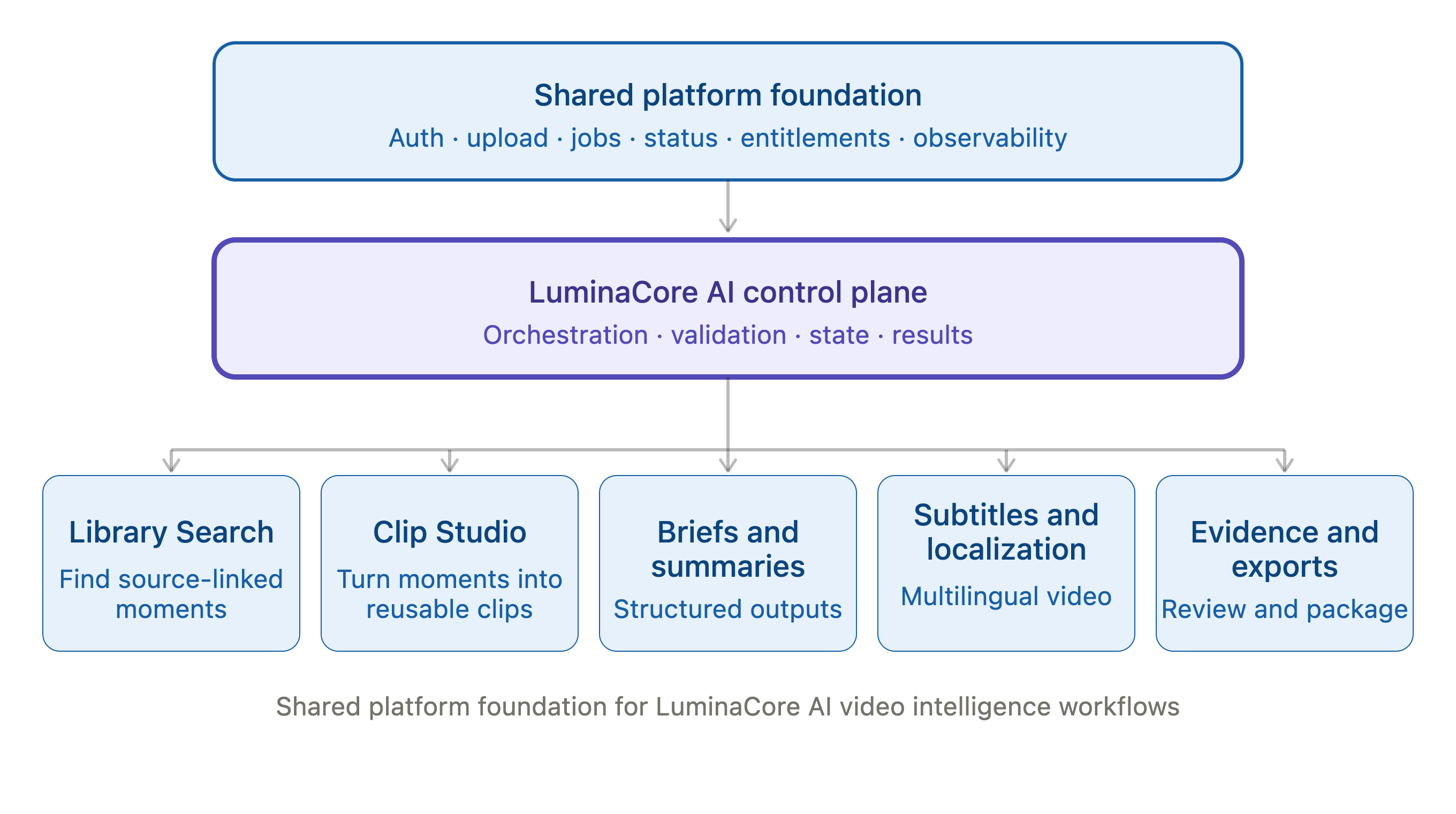
Shared foundation with workflow-specific behavior
Although LuminaCore AI workflows differ in output and user experience, they are not separate systems. They are extensions of a shared platform layer that provides common services, including authentication, uploads, job tracking, status reporting, results storage, pricing and entitlement checks, and observability.
This lets LuminaCore AI support multiple workflow surfaces without duplicating infrastructure or introducing accidental complexity.
Logical system architecture: end-to-end view
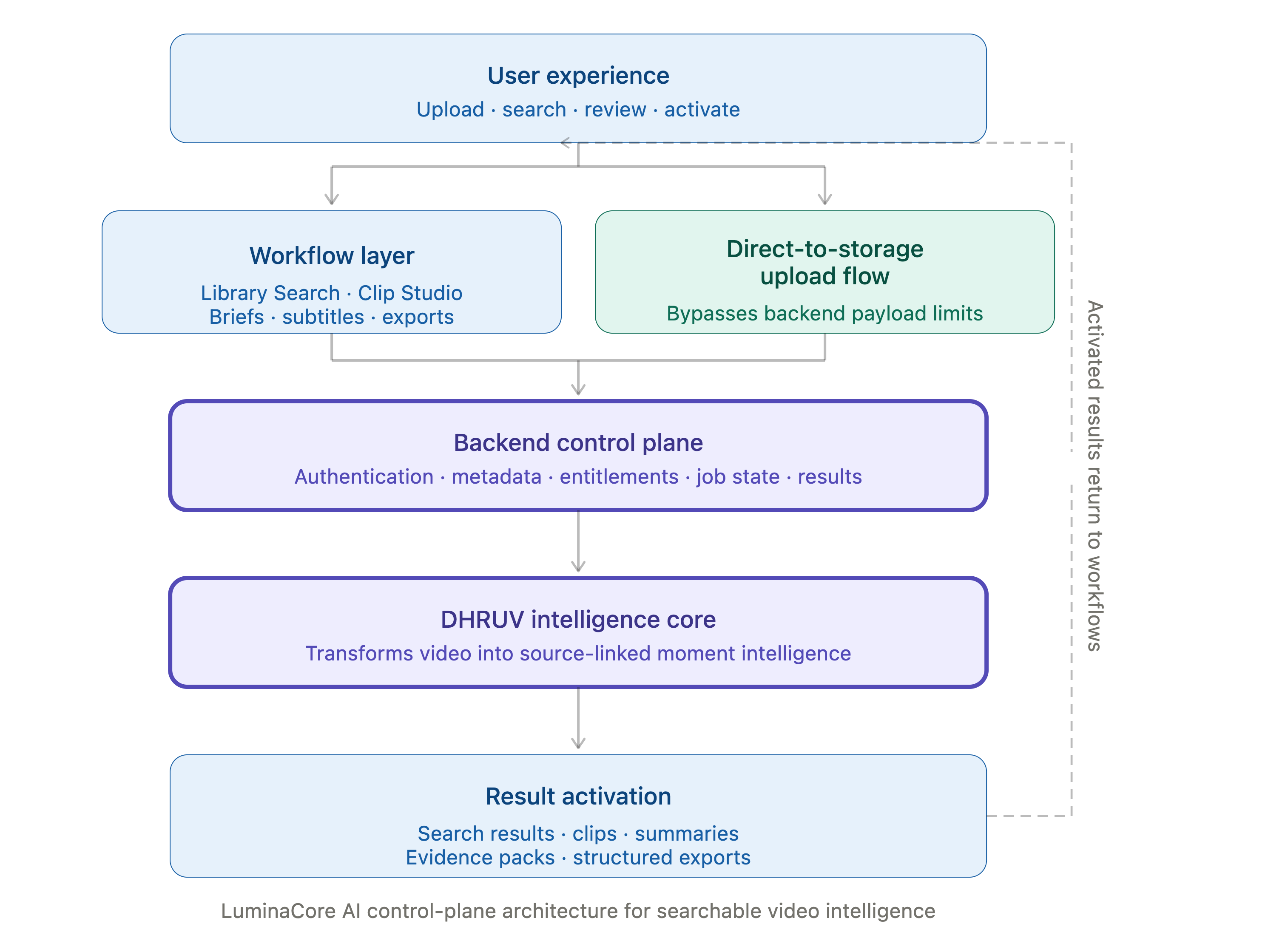
From an execution standpoint, LuminaCore AI follows a clear separation of responsibilities. The browser handles large video upload through a direct-to-storage flow. The backend control plane validates requests, creates jobs, enforces commercial and operational rules, and exposes job status and results. Video intelligence processing runs asynchronously and reports progress through well-defined lifecycle states.
This design avoids backend bottlenecks, simplifies failure handling, and allows long-running workflows to progress independently of user sessions.
Why this architectural split works
Large video assets should not be routed through the backend as ordinary request payloads. They need a dedicated upload path that scales independently of API throughput.
The backend remains focused on control-plane responsibilities: metadata validation, job creation, accounting, orchestration triggers, status updates, and result delivery.
The frontend remains reliable because it communicates with the backend through a clear domain-oriented API surface. This structure allows long-running workflows, retries, and partial failures to be handled predictably as the system evolves.
Pricing and entitlements as architectural concerns
Pricing in LuminaCore AI is not a billing detail layered on top of processing logic. It directly shapes how jobs are created, validated, and executed.
Video intelligence workflows consume expensive resources. Some workflows may be governed by credits. Others may depend on account entitlements, usage limits, subscription rules, or payment confirmation. In every case, the core architectural principle is the same: expensive processing should not begin until the system has established that the user is allowed to run the job.
This is why economic validation belongs inside the control plane.
Before a job moves into execution, the system validates the relevant commercial and operational constraints. This keeps compute usage aligned with user permissions, account limits, and cost responsibility. It also prevents ambiguity during retries, partial failures, or interrupted user sessions.
By treating pricing and entitlement checks as part of job orchestration, LuminaCore AI keeps system behavior predictable under failure and scale.
The frontend as a control-plane participant
In LuminaCore AI, the frontend is not treated as a passive rendering layer. It actively participates in distributed workflows that include large-file uploads, payment or entitlement validation, long-running asynchronous jobs, status polling, review flows, and result activation.
To support this, the frontend is intentionally layered. UI components interact with domain-specific workflow logic, which delegates to service layers and a typed API surface responsible for authentication, retries, and error handling. This structure allows the frontend to evolve alongside the backend without becoming fragile as features expand.
Public-facing architecture choices
Several decisions are worth highlighting because they directly support reliability and long-term maintainability without exposing proprietary internals.
- Separate public, marketing, and authenticated product routes to reduce accidental coupling between growth-facing pages and product workflows.
- Use persistent client-side state where necessary so long-running workflows can survive refreshes, navigation, and interrupted sessions.
- Keep a typed API integration layer between frontend and backend so authentication, retries, and error handling are consistent.
- Use predictable job status updates for long-running video intelligence workflows instead of hiding progress behind vague loading states.
- Treat pricing, entitlement, and usage checks as part of orchestration rather than as an afterthought.
- Preserve clear boundaries between source upload, control-plane coordination, video intelligence processing, and result activation.
Key takeaways
For AI video products, the hardest production challenges often sit outside the intelligence layer itself. Reliable systems must handle large asset ingestion, asynchronous workflows, partial failures, economic enforcement, frontend coordination, and clean contracts between product surfaces and backend services.
LuminaCore AI's architecture is designed around these constraints from the outset. DHRUV transforms video into searchable, source-linked moment intelligence. SHAKTI turns that intelligence into workflows. The control plane coordinates the operational reality around both: ingestion, orchestration, validation, state, pricing, results, and reliability.
That separation allows LuminaCore AI to remain extensible, predictable, and operationally sound as the platform grows.